Article
October 28, 2025
time
-min
read
Frogs, Frankenstein, and VNS
The inspiration for Frankenstein is worse than fiction, but instrumental in understanding how nerves work.
.png)


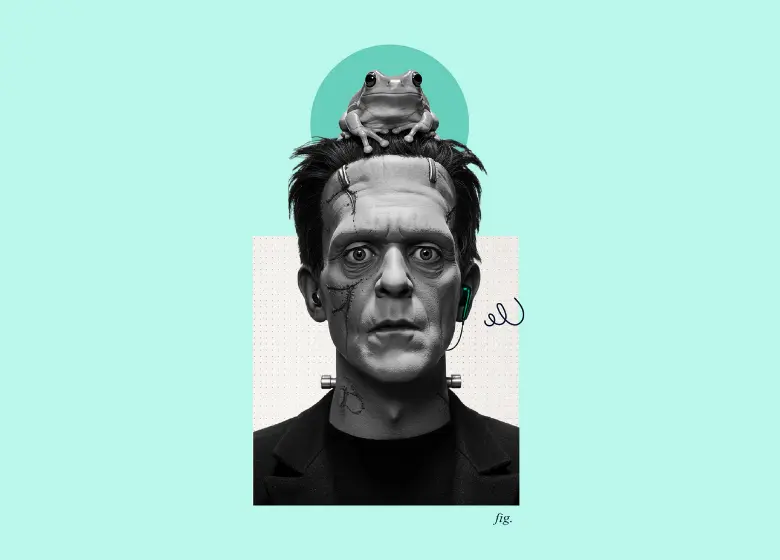
A steel table, metal probes, and life-giving lightning are the images accompanying the creation of Frankenstein’s monster. Mary Shelley’s Frankenstein is a glimpse into very real scientific pursuits of the 18th century that formed the foundations of our understanding of nerves and muscle tissue, including the vagus nerve.
While 8-foot human scrapbooks weren’t plaguing Europe, scientists in the 17th and 18th centuries were experimenting with animal reanimation, using electricity. Shelley spent years studying these scientific breakthroughs and took inspiration from the findings when writing Frankenstein.
Science seems to have a fascination with frogs, and the history of understanding nerves has amphibians to thank for their role in early experimentation.
Jan Swammerdam was a 17th-century naturalist and philosopher known for creating the Bybel der Natuure (Bible of Nature) — a collection of studies on insects which, at the time, included frogs. Swammerdam’s interest in frogs had theological and scientific goals: he wanted to prove that all creatures were created by God and governed by the same biological rules. Swammerdam used similar muscle experimentation methods on frogs as those used on larger animals like cats and dogs. He exposed the leg nerves and used sharp instruments to stimulate contractions, showing a closer link between frogs and humans than was previously thought.
Luigi Galvani’s inquiry into reanimation started with a frog, a static electricity machine, and a scalpel. A frog’s leg nerves were exposed near a charged electrical machine when Galvani’s wife touched a nerve with a scalpel, causing the leg to spasm. Noting that the scalpel had been near the static electricity machine shortly before his wife had used it to touch the frog, Galvani formed and tested his theory that electrical force could travel along the nerves to the muscles, causing them to contract. He called this “animal electricity”.
Galvani also found that nerves from one frog could be attached to the muscles of another, and that the muscles from the second frog responded when the nerves were stimulated.
Shortly after Galvani published his findings, another professor of physics named Allesandro Volta disputed the notion of “animal electricity”, causing controversy in the field. By repeating Galvani’s experiments with frogs, Volta concluded that the key to nerve stimulation was in agitating them with two differing types of metal. The more dissimilar the metals, the more intense the reaction. Galvani would later disprove this by using two rods made of the same type of metal to cause muscle contractions. The result of their scholarly dispute? Both were partially right and wrong: there is no “animal electricity”, but nerve stimulation doesn’t require two differing metals to achieve.
Galvani’s nephew, Giovanni Aldini, continued his uncle’s work by publicly animating the corpses of executed criminals. Aldini inserted metal rods into the corpses and stimulated muscle movement with electricity, demonstrating a macabre display of galvanism and leading to questions about bringing back the dead.
These galvanist pursuits weren’t the only inspiration for Shelley — the author cites Erasmus Darwin (grandfather to Charles Darwin) in two editions of her work.
Erasmus Darwin was a physician, botanist, and poet, and amongst his publications on plants and evolution, he wrote on reanimation in dead microorganisms.
Arguably, the most influential figure in crafting Frankenstein was Sir Humphry Davy, a friend of Shelley’s father who allegedly inspired the character Victor Frankenstein.
Davy was a professor of chemistry at the Royal Institution in London, with crowds overfilling his lecture hall to watch his experiments. Davy used Volta’s invention—the electric pile—to investigate and prove that electricity generation depends on a chemical reaction. Shelley used some of Davy’s lectures as dialogue for Victor Frankenstein and tried to capture the professor's passion for understanding nature and his drive to master it.
Non-invasive vagus nerve stimulation (nVNS) is a form of mastery over nature. Short bursts of electrical energy are passed through the vagus nerve to relax the stress response, improve nervous system function, recalibrate certain regions in the brain, and control inflammation. What scientists learned about the effect of electrical impulses on nerves from their experiments hundreds of years ago, we use now to regulate the digestive system, improve mood, and manage chronic pain disorders via the vagus nerve.
Fortunately, nVNS can be done at home, sans steel table and metal probes.


Ph.D.
Lead of Clinical Well-Being
Public health, fitness, academia, and MedTech specialist, Atkinson has 25+ years in turning research into real-world impact.



DC, AFMCP, AcuP
Vagal Health Advisor
Director at large of the Vagus Nerve Society and author of Activate Your Vagus Nerve, Habib has 15+ years of experience in chiropractic and functional medicine.

Ph.D.
Behavioral Psychology Advisor
Associate Professor of Public Policy, Business Administration, and Psychology, and world-renowned behavioral scientist, Adams has 21+ years of experience and focuses mainly on processes that drive better decision-making.

M.D., Ph.D., FASRA
Chief Medical Officer
An expert in anesthesiology and specializing in vagus nerve stimulation, André ensures yōjō is safe, effective, and grounded in rigorous scientific research. He also helps develop yōjō's educational resources.
Up next

.png)
Article
September 16, 2026
time
-min
read
Meet Your Coach Dr. Ayesha Bradlow
“I didn’t think the coach was a human, so I didn’t engage.”
We’ve heard this quite a lot from yōjōers, and potential yōjōers have said they wouldn’t want another chatbot in their lives. We realized we hadn’t done enough to show that yōjō well-being coaches are human, that real fingers are tapping away on the other side of the chat, and that online coaching sessions are between humans. So we sent a film crew to interview Ayesha, yōjō’s well-being coach, to show that every yōjōer has a gloriously human professional supporting their journey.

Article
August 14, 2026
time
-min
read
How Do You Know If Your Nervous System Is Dysregulated?
"I just feel a bit off, not myself, but I don't really know why." Here’s why.
As a wellbeing coach and health psychology specialist, I've worked with hundreds of clients — executives running global teams, athletes preparing for competition, busy working parents spinning a dozen plates — and one of the most common things I hear, in slightly different words each time, is: "I just feel a bit off, not myself, but I don't really know why."
What strikes me is how rarely people connect that feeling to their nervous system.
It's not their fault. Nervous system regulation isn't something we're taught about in school, and the symptoms often don't feel serious enough to bring to a healthcare professional.
So when something feels off, most people don't know where to look for answers. And they end up tolerating a low-grade version of themselves for months, sometimes years, before joining the dots.
So before we get into this further, let’s do a simple check-in to see if your nervous system might be a little out of sorts.
A few questions to ask yourself
Sit with these for a moment. There's no scoring system, and this isn’t a diagnosis. Just be really honest about whether any of these describe you right now, and if there’s a pattern across more than one area.
- Do you find it hard to fall asleep even when you're exhausted? Do you wake at 2 or 3 am with a busy mind? Or, do you get a full night’s sleep yet wake unrested?
- Do you feel "tired but wired", too depleted to do much and too revved up to rest? Do you crash in the afternoons, then get a second wind late at night?
- Is your concentration patchier than it used to be? Are you losing words mid-sentence, walking into rooms and forgetting why, or finding tasks that used to be easy harder?
- Are you more reactive than usual — tearful, snappy, anxious — over things that wouldn't normally land that hard? Or the opposite: flat, numb, a little disconnected from yourself and the people around you?
- Is your jaw tight? Shoulders up by your ears? Heart occasionally racing for no clear reason? Has your digestion become unpredictable? Do bloating, reflux, irregular bowels, sensitivities seem to be multiplying?
- When something stressful happens, how long does it take you to genuinely come back down? Hours? Days? Or does it feel like you never quite return to baseline at all?
If you're nodding along to several of these — particularly across more than one category — it's worth taking seriously. This is what a dysregulated nervous system tends to look like in real life. Not dramatic. Not always alarming. Just a steady accumulation of small signals.
Why this happens — even when you're coping
Here's the part that often lands hardest with my clients: you can be coping and be dysregulated at the same time. In fact, that's the most common presentation I see.
You're still showing up, still hitting deadlines, still being a good parent, a reliable friend, a strong performer. From the outside — and often from the inside too — it looks like things are working. And they are, but your body is keeping score. And it's beginning to show you, in quiet ways, that the system needs some help.
To understand why, it helps to know a little about how your autonomic nervous system works.
Your autonomic nervous system has two main branches, the sympathetic (fight-or-flight) and the parasympathetic (rest-and-digest). A balanced system switches fluidly between the two throughout the day. You ramp up for a meeting, then come back down. You handle a stressful conversation, then return to baseline. That movement between states is what we mean by regulation.
Dysregulation isn't about being stressed. It's about losing the ability to come back down. When the body lives in a state of low-grade activation for long enough — from demanding work, caring responsibilities, illness, unresolved emotional load, or simply years of pushing through — the system stops returning to baseline between stressors.
Your sleep gets lighter. Your digestion gets touchier. Your mood gets thinner. Your thinking gets foggier. None of it is dramatic in isolation. All of it points to the same underlying issue.
The symptoms above, while seemingly random and tied to character flaws, are just your physiology responding to you running hot for too long without a proper reset.
Where to go from here
The first piece of work is recognition, which is what this article has really been about. And it is what asking yourself those questions at the top will help ignite. And if they have helped you identify something worth addressing, there is good news.
Your nervous system can relearn any flexibility it may have lost.
Quitting your job, ditching your caring responsibilities, or running away to a tropical island won’t help you rebalance your nervous system long-term. Teaching your system that it's safe to come down will. Consistently engaging in small daily rituals that activate your rest-and-digest response helps your body to learn how to switch back into this mode more easily and fast-track you back to feeling more like yourself.
.png)
Article
August 7, 2026
time
-min
read
Dr. André Boezaart’s Perspectives on nVNS
yōjō Chief Medical Officer, André Boezaart, reflects on stress, the senses, and the vagus nerve.
By André P. Boezaart, MD, PhD, FASRA
It helps to think of the human nervous system as four connected parts, each with its own job.
The central nervous system (CNS) is the brain and spinal cord. It is the command center. It handles thoughts, feelings, and decisions.
The autonomic nervous system (ANS) runs the jobs you never think about but can't live without: your heartbeat, your breathing, digestion, and blood flow.
The somatic nervous system (SNS) controls the movements you choose to make and facilitates your senses. It is your link to the outside world.
The enteric or "gut" nervous system (GUT) lives in your digestive tract. It has more nerve cells than your spinal cord, and it acts like a mind of its own, talking to the brain all day through nerve and chemical signals.
Together, these four systems work like a piece of music. Each part matters. Harmony is the goal. When one section plays too loudly, the whole piece falls out of tune.
When the stress system gets stuck
Inside the autonomic nervous system are two branches that keep each other in check.
The sympathetic system is the accelerator (fight-or-flight). The parasympathetic system is the brake (rest-and-digest).
In modern life, the accelerator often gets stuck. Alerts, deadlines, and worry keep the sympathetic system running hard, all the time.
What was meant for short bursts of alertness becomes prolonged hypervigilance. What was meant to be a useful alarm turns into slow harm.
A gland called the adrenal medulla releases catecholamines (stress hormones like adrenaline) and doesn’t stop. And another system, the hypothalamic–pituitary–adrenal (HPA) axis, releases cortisol, and doesn’t stop.
The immune system slips into a low, simmering, inflamed state. Inflammatory signals called cytokines rise, blood vessel linings work less well, and the gut wall becomes leakier and weaker.
The nervous and immune systems, which are meant to be partners, start working against each other.
Calming the body through the senses
You wouldn’t think it, but your senses play a role in spreading calm throughout your nervous system. Each of the five senses offers a direct path to the parasympathetic system. These paths evolved to tell the body one thing: you are safe.
Sight. When your eyes rest on something wide and open, like mountains or the ocean, the visual part of the brain sends calming signals inwards. This lowers activity in the amygdala, the brain's alarm center. A soft, wide gaze actually slows your heart.
Hearing. Gentle, patterned sounds calm us. Think of a mother's sing-song voice to a baby, a soft hum, ocean waves, or soothing music. These sounds work the tiny muscles in the middle ear and activate the vagus nerve. Your body tunes toward connection instead of defense.
Smell. Scent has a direct line to the brain's emotion centers. Aromas like lavender, bergamot, and frankincense lower stress activity and lift vagal tone (the strength of the calming vagus nerve).
Taste. Eating mindfully wakes up taste nerves that run along cranial nerves VII, IX, and X. This releases feel-good chemicals like dopamine and endorphins and gets digestion moving, which is part of the vagus nerve's territory.
Touch. Massage, firm pressure, and gentle skin contact switch on special nerve fibers called C-tactile afferents. These signal safety and belonging. They raise oxytocin (a bonding hormone) and boost the calming system.
Put together, these signals tell the body you are safe and free to heal.
The vagus nerve: the body's anti-inflammation highway
At the center of all this calming is the vagus nerve, the tenth cranial nerve. It is a two-way highway linking the brain, the organs, and the immune system.
About 80% of its fibers are afferent, meaning they carry information up to the brain. They send sensory signals from the organs and body, including from parts of the outer ear called the cymba and cavum conchae, back to the brainstem.
Its efferent fibers carry signals the other way, down from the brain. They switch on the cholinergic anti-inflammatory reflex.
Here's how that works: the vagus nerve releases a chemical called acetylcholine. It attaches to receptors on immune cells called macrophages. This lowers inflammatory signaling.
This link between the nervous and immune system is what allows thought, emotion, and inflammation to "talk" to each other in real time.
Bundling the senses at the ear
When we stimulate the part of the vagus nerve in the outer ear, in the cymba and cavum conchae, we tap straight into those calming afferent (sensory) pathways.
Transcutaneous auricular vagus nerve stimulation (taVNS) sends gentle electrical pulses to the very same circuits that music, touch, scent, and beauty stir up on their own.
It's as if all five senses were bundled into a single clear signal, all arriving together at a hub in the brainstem called the nucleus tractus solitarius.
Then, using the vagus nerve, the brain sends calming signals back down into the body. It steadies the heart, settles the gut, and quiets inflammation through that same acetylcholine pathway.
taVNS does not replace the senses. It amplifies their message. It reminds the nervous system what safety feels like.
Closing thought
At its heart, the path from stress to healing is a shift from sympathetic noise to parasympathetic calm.
Beautiful views, gentle sounds, soothing scents, delicious meals shared with loved ones, and a caring touch all send the same message the vagus nerve carries in every heartbeat: Be still.